The apartment is quiet after work, and the only light in my study comes from a warm desk lamp and three game-information panels on my laptop. One screen shows two blue gems, a wild symbol, and what looks like a completed line. That small result sends me back through the paytable, the feature description, and a note I keep beside the keyboard.
Understanding How Wild Symbols Work in Online Slots starts with a simple idea: a standard wild acts as a substitute symbol for eligible regular paying icons. If two matching symbols already sit in the required pattern, a wild may fill the missing position and create a qualifying win. The animation makes this look effortless, yet the rules behind it matter.
Every slot defines its own version of “eligible.” A wild may appear on only three reels, stay out of the first reel, work differently during free spins, or exclude every special icon. Some wilds also carry their own payout. When an all-wild line and another symbol combination are both possible, the game applies its stated evaluation and payment rules. My early mistake was assuming the familiar WILD label meant familiar behavior. Comparing several help screens quickly cured that assumption.

How Wild Symbols Work in Online Slots on a Winning Pattern
Imagine a five-reel payline game. The center row lands blue gem, blue gem, WILD, orange, crown. The paytable says three blue gems pay when they appear on an active line from left to right. Here, the wild takes the role of the third blue gem. The first three positions are adjacent, begin on the required side, and sit on the same active payline, so the combination qualifies.
The wild does not erase the underlying pattern rules. If the symbols sit on different inactive lines, the result fails. If the paytable requires four matches, three positions remain insufficient. A right-to-left sequence counts only when the help screen allows that direction. In fixed-payline games, you also need to know whether all lines are always active or whether the chosen stake activates a stated number of lines.

Ways-to-win slots evaluate positions through their own reel-based system, often requiring matching eligible symbols on adjacent reels from a specified side. Cluster games may require a connected group of a minimum size. A wild can supply an eligible match inside either structure, yet it cannot make separated symbols adjacent or shrink the required cluster.
When a wild could represent more than one regular icon, the game software evaluates the eligible outcomes under its rules. Many games award the highest qualifying win for that payline or way; others can pay multiple distinct wins. That detail belongs in the paytable. It is safer to read the rule than to infer it from a celebratory animation.
| Symbol type | Typical role | Can a standard wild usually replace it? | What to verify |
|---|---|---|---|
| Regular paying symbol | Forms line, ways, or cluster wins | Usually | Eligible icons, direction, and minimum count |
| Scatter symbol | Pays or triggers a feature through its own placement rule | Usually no | Whether substitution is explicitly allowed |
| Bonus symbol | Starts or advances a bonus feature | Usually no | Required number and eligible reels |
| Jackpot or prize symbol | Awards or collects a stated prize | Usually no | Trigger, collection, and stake conditions |
| Coin or collection symbol | Adds values, tokens, or progress | Usually no | Feature state and collection rules |
A scatter symbol deserves special attention. It often counts anywhere on the reels or in named positions and can trigger free spins without following a payline. Bonus, jackpot, prize, coin, and collection icons also tend to have dedicated logic. Exceptions exist, so words such as “substitutes for all symbols except…” are among the most useful lines on the screen.
The Wild Changes When the Feature Changes
I switch to the next information panel and see a wild stretched across several spaces. The label is familiar; the timing is new. Modern slot wilds are often defined by where they appear, what activates them, and how long they remain. Those conditions can change between the base game and free spins inside the same title.
| Variant | Behavior | Typical duration | Easy-to-miss rule |
|---|---|---|---|
| Stacked wild | Places wilds in adjacent positions on one reel | Current spin | The stack may be partial or limited to certain reels |
| Expanding wild | Enlarges to cover a reel, row, or defined area | Current spin or feature | Expansion may require a qualifying landing position |
| Sticky wild | Remains in place for later respins or feature spins | Stated number of spins | Persistence may apply only within one feature |
| Moving or walking wild | Changes position on subsequent spins | Until it exits or the feature ends | Direction, movement rate, and final position vary |
| Random wild | Is added to selected positions by a defined feature | Usually current spin | It may be unavailable at some stakes or game states |
| Multiplier wild | Increases a qualifying win containing that wild | Current win or stated feature | Multiple values may add, multiply, or use one value |
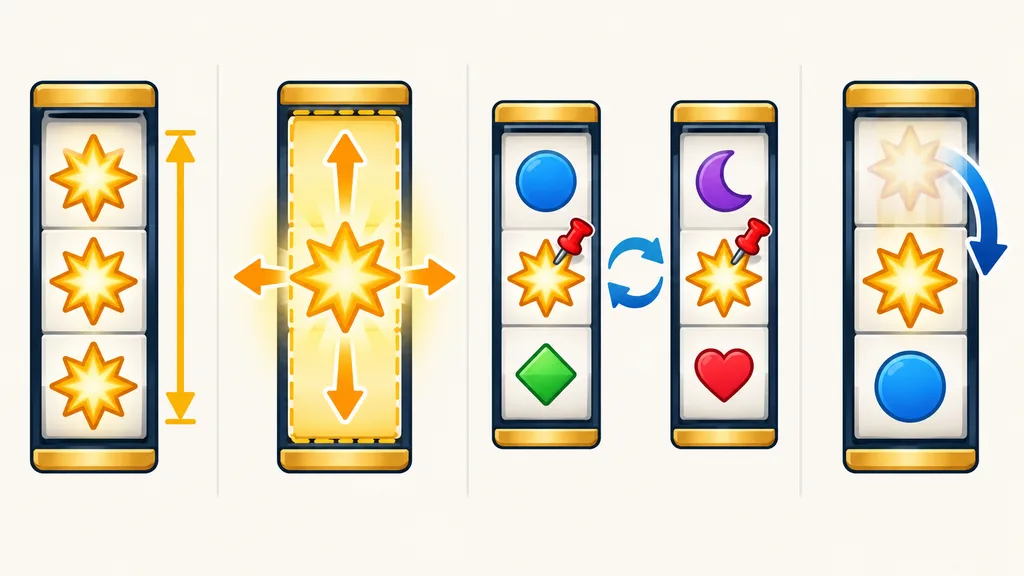
A stacked wild describes layout: several wild positions appear together. An expanding wild describes a change in coverage after its trigger condition is met. A full stack may resemble a fully expanded reel, though the help text can reveal different eligibility and activation rules. A sticky wild describes persistence. It remains where it landed for the stated respins or feature spins, then disappears when that sequence ends.
Moving or walking wilds persist and shift according to a route, commonly one reel per subsequent spin. Random wilds are placed by a feature whose trigger and eligible positions should be stated. “Random” does not mean the player can influence where they land. Multiplier wilds apply a value such as 2x or 3x to a qualifying win, with the exact calculation controlled by the game.
Official game descriptions illustrate the variety. Play’n GO’s Bull in a China Shop describes stacked and multiplier wild behavior and says multiplier wild wins do not accumulate on the same payline. Its 3 Clown Monty describes sticky multiplier wilds and multiple values multiplying a qualifying line win. 3 Pots of Gold offers another pattern: published information describes a persistent wild that moves upward in the base game and behaves differently during free spins. Each title supplies its own rule set.
The practical lesson is to track four things together: eligible reels, activation condition, duration, and feature state. A wild available on reels two through five in the base game may move, lock, gain a multiplier, or vanish during free spins. Elaborate behavior also gives no standalone evidence of better odds, a higher return, or profitable play. It is one component already included in the game’s mathematical design.
Read the Paytable Before the Reels Start
Back at the first game, I open my saved checklist and move between the paytable and feature tab. This takes a minute and prevents most misunderstandings. You can use the same sequence before choosing whether a slot’s rules are clear enough for you.
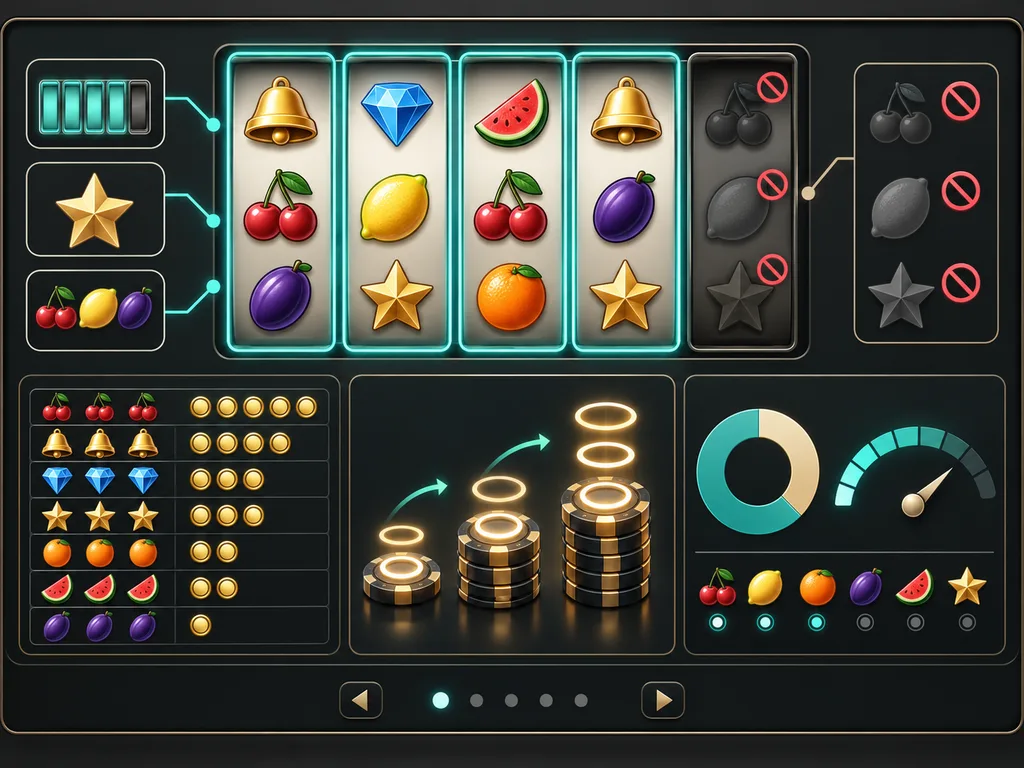
- Find the exclusions. Record whether the wild can replace scatters, bonus icons, jackpot symbols, coins, prizes, and collection symbols.
- Check every eligible position. Note which reels, rows, or grid cells can contain the wild, including any restriction on the first or last reel.
- Look for a wild payout. See whether the wild has its own value and how an all-wild combination is evaluated.
- Confirm the win pattern. Read the required direction, adjacency, active paylines, ways-to-win pattern, cluster size, and minimum number of matching symbols.
- Measure persistence. Identify how many respins or feature spins a sticky or moving wild survives, what makes it move, and when it resets.
- Compare game states. Check whether the wild changes during free spins, a hold-and-win round, or another bonus.
- Resolve multiplier combinations. Learn whether multiple wild values multiply together, add together, use the highest value, or apply separately. Also confirm whether the multiplier affects the whole win, one line, or one way.
- Check settlement. Determine whether only the highest qualifying interpretation is paid or whether separate wins can be awarded together.
- Read the stake basis. Confirm whether displayed awards are coin values, total-bet multiples, line-bet multiples, or fixed amounts, and whether stake affects feature access or prize eligibility.
- Locate RTP or probability information. Treat RTP as a long-run theoretical measure across many plays. Never use it as a forecast or repayment promise for your session.
For context, the rules here depend on jurisdiction. The UK Gambling Commission’s standards for Great Britain licensees require applicable rules, winning determination, potential payouts, and RTP or probability information to be readily available before play. This makes the help panel a useful decision tool.
Regulated testing also provides useful context without turning wilds into a strategy. The Commission’s testing strategy covers statistical analysis of RNG output, mathematical verification, source-code review, player-facing rules, and expected RTP checks for relevant licensed products. A recent wild, a near miss, or a losing sequence therefore offers no reliable signal about the next random outcome.
Feature knowledge still has value. It helps you understand why a line paid, recognize when a special symbol was excluded, compare two games consistently, and set sensible limits around entertainment. It cannot remove the house advantage or ensure a win. I close the flashy animation, return to the information panel, and work down the list once more. The wild is restricted to three reels, the scatter is excluded, and two multipliers use the highest value only. With those rules visible, I can decide whether the game is understandable enough to play and leave it closed when it is not.