The room is quiet after work, and the glow from my laptop is the brightest thing in my apartment study. Two bonus symbols land. The third scrolls into view, slows down, and stops one position beyond the trigger. For a second, the screen feels as if it has shown me progress.
So, are slot near misses designed to make you keep playing? Some slot presentations may be designed to make an almost-win feel noticeable and engaging, and research shows that near misses can affect attention, emotion, arousal, and the desire to continue. That does not prove the intention behind every game or show that every player will spin longer. A near miss is simply a losing result that visually resembles a win, such as two matching symbols followed by a different one. It does not predict the next spin.
“One Symbol Away” Means I Was Mathematically Close
Reels turn a numerical selection into a visual story. In a typical online slot, a random number generator supplies values that the game maps to reel positions or outcomes according to its rules and paytable. The animation then displays that completed result. The exact technical sequence varies among games, so the help screen is the right place to check how a particular title describes its operation.
A symbol immediately above a payline looks physically close because the interface presents a strip of images moving through space. Mathematical probability does not have to follow that visual distance. A bonus symbol one position away may represent a losing outcome with no special connection to the winning combination. The screen can create a vivid sense of proximity while providing no useful forecast.
For ordinary independent spins, the next RNG outcome is a new event. Previous losses, wins, and near misses do not build invisible credit toward a regular win. A documented feature can have persistent state—for example, a clearly explained collection meter—but that mechanism should appear in the rules. You should never infer one from reel placement alone.
| What the display can make you feel | What you can safely infer |
|---|---|
| “The bonus is getting closer.” | The current spin lost unless the paytable says it awarded something. |
| “The next spin has improved odds.” | A visual near miss gives no predictive information about the next independent outcome. |
| “I nearly selected the right moment.” | Timing has no established value unless the published rules describe a real skill element. |
This distinction matters when a reel animation is slow or dramatic. Emotion reads distance; the account balance and transaction record settle the result.
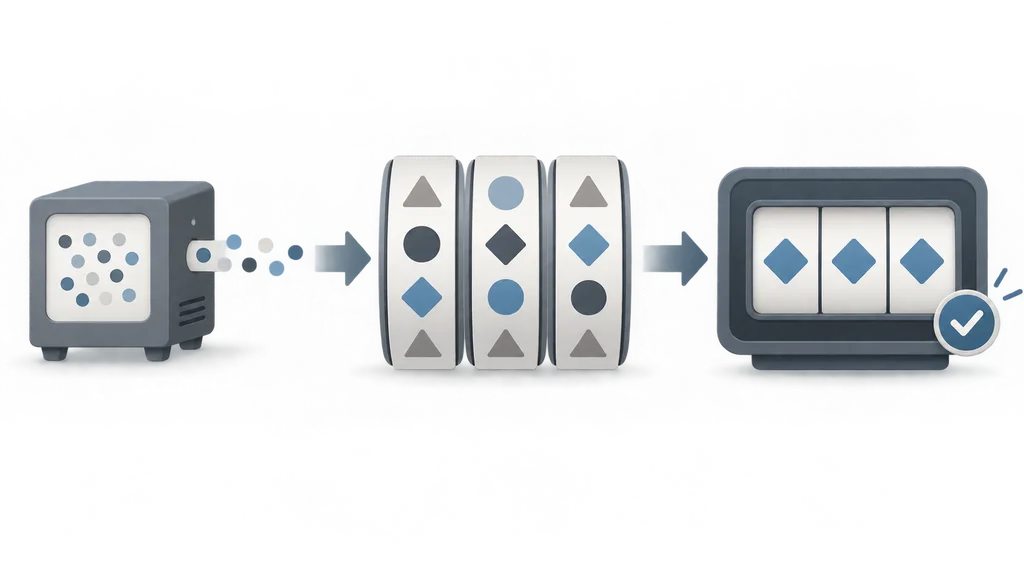
Every Near Miss Proves the Casino Changed My Result
A suspicious-looking loss does not, by itself, prove that an operator replaced a win or altered your spin. Slot mathematics and reel layouts can naturally produce many losing combinations that resemble winning patterns. If matching symbols and bonus symbols appear on the reels, some losing arrangements will inevitably place them near active positions.
Presentation still involves deliberate choices. Designers choose symbol artwork, reel pacing, sound, highlighting, and the positions visible around an active line. Those choices can make one loss more salient than another. Yet observing a dramatic pause cannot establish what a developer intended, how the underlying outcome was generated, or whether a rule was breached. Different games, suppliers, and markets operate under different technical requirements.
The United Kingdom offers a useful regulated-market example. Under the UK Gambling Commission’s RTS 7 standards, RNG output and game results must be acceptably random, outcome probabilities must remain unpredictable, and adaptive or compensated behavior is prohibited. The standards also require the mapping of random inputs to follow the stated probabilities and paytables.
RTS 7C addresses misleading presentation. It prohibits substituting losing events with near-miss losing events, and its guidance says a game may not swap one loss for another merely to show a false near miss. That rule helps separate a genuine generated losing layout from a misleading replacement display. It does not mean near-miss-looking outcomes can never appear in a compliant game.
These are UK requirements, not a universal description of regulation. Other jurisdictions may use different testing, certification, disclosure, and display rules. An unlicensed site may offer much weaker assurance. When I compare slot sites, I check the named regulator, verify the licence on the regulator’s own register, and read the game help screen. A logo in a footer is not enough evidence on its own.
Science Proves Near Misses Always Extend Play
The strongest careful answer is that near misses can influence players, while their effect on measurable play is conditional and mixed. A systematic review of 51 experimental studies reported effects involving motivation, emotional response, physiological arousal, and persistence. It also found variation across studies and outcomes.
That difference between internal response and observable behavior is important. A near miss may feel frustrating, capture your attention, raise arousal, or produce a stated desire to continue. Those reactions do not guarantee another spin, a larger next bet, or a longer session. Studies have used different machines, laboratory tasks, participant groups, near-miss definitions, and measures. Some recorded session length; others examined response timing, bet adjustment, subjective ratings, skin conductance, or brain activity.
| Finding | What it suggests | Important limitation |
|---|---|---|
| Near misses often receive stronger emotional or physiological responses than full misses. | An almost-win can be psychologically salient. | Arousal does not establish longer play for every person. |
| Some experiments found greater motivation or persistence. | Near misses can encourage continued play under certain conditions. | Effects vary with task design, measure, and participant group. |
| Bet size, response time, and total gambles have shown inconsistent patterns. | Behavioral effects are not uniform. | One measure cannot stand in for all real-world session behavior. |
| Some imaging work found activity in regions also involved in responses to wins. | Near misses may engage parts of reward-related processing. | Neural activity does not prove mind control, addiction, or inevitable action. |
In a controlled slot task with 40 healthy volunteers, Clark and colleagues found that participant-chosen near misses increased self-reported motivation to continue compared with full misses. Personal control mattered in that setup. The same research associated near misses with activity in some regions also recruited by wins, while participants still rated near misses as unpleasant. It was a specific laboratory task, so it cannot settle how every commercial slot affects every player.
A later review and experimental analysis by Pisklak, Yong, and Spetch reached a more skeptical behavioral conclusion. Their controlled experiments did not support a consistent reinforcing effect of near misses on gambling-response frequency. Read together, the research supports a measured position: the slot near-miss effect can shape experience and motivation, while evidence that it reliably causes more bets or longer sessions remains unsettled.
Pressing at the Right Moment Makes the Near Miss Informative
Touching the screen, choosing a symbol, or pressing a stop button can make a result feel personal. Researchers often discuss this through the illusion of control: an action creates a sense of influence even when it has no demonstrated effect on the random outcome. The Clark experiment is relevant because participant choice changed reported motivation after near misses under its laboratory conditions.
Ordinary online slots use many interface styles. On one game, a stop control may simply shorten the animation after the result has been determined. Another game may describe an interactive feature with its own rules. The presence of a clickable control tells you very little by itself. Read the rules before assigning mathematical meaning to it.
- A manual stop: check whether it changes outcome selection or only display speed.
- A pick feature: check whether choices reveal predetermined values or involve a documented decision.
- A collection meter: check whether progress persists and exactly what triggers the feature.
If the published rules do not describe a genuine skill component, there is no sound basis for believing that faster reactions, a preferred stopping rhythm, or a symbol choice improves the odds. A near miss after your input is still a completed loss. It does not show that your timing was nearly correct, and it does not reveal where the RNG is heading.
Use the Result as a Stop Signal
The practical response is simple: classify the spin by its actual return, then follow limits chosen before the animation had a chance to influence you. Near misses deserve attention because they can feel powerful, not because they contain strategic information.
- Record the result accurately. If the paytable and balance show no award, call it a loss. Keep it separate from a loss disguised as a win, where a payout smaller than the stake arrives with celebratory feedback.
- Set money and time limits in advance. Include a firm stop point and treat it as part of the session plan, regardless of the symbols on the final spin.
- Reject “finishing the pattern.” Extra spins cannot complete a pattern that exists only in past independent results. Never use a near miss as a reason to add funds.
- Check the rules and licence. Look for documented meters, feature persistence, stop-button behavior, RNG information, and the regulator responsible for the market.
- Leave when chasing appears. Frustration, hurried betting, and thoughts about recovering losses are useful cues to close the game.

In my own after-work comparison routine, the best reality check is the dullest screen: the transaction history. The animation may say “almost,” while the ledger says the spin is over. Once my preset limit arrives, that completed record closes the session; the nearby symbol gets no vote.